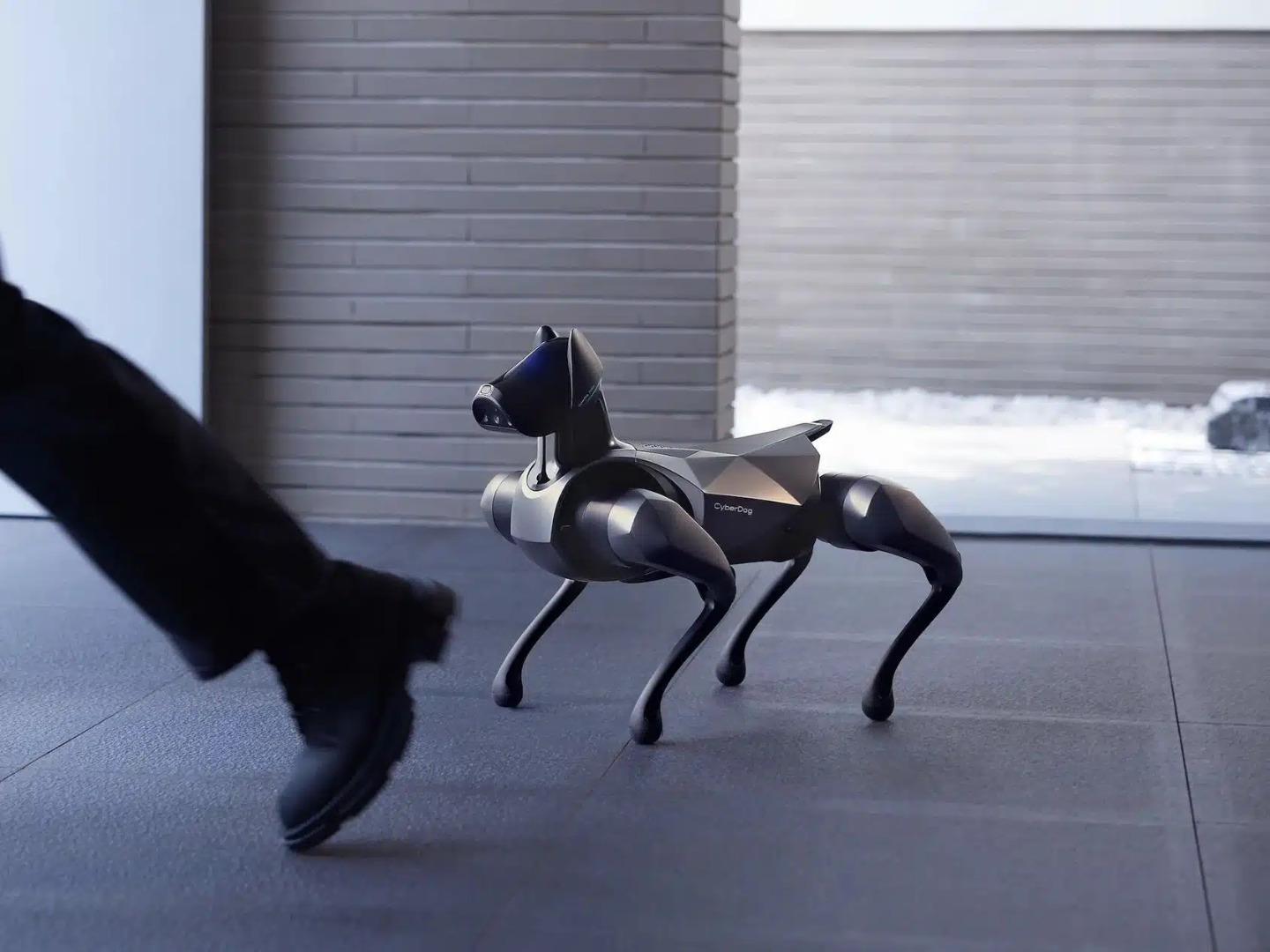
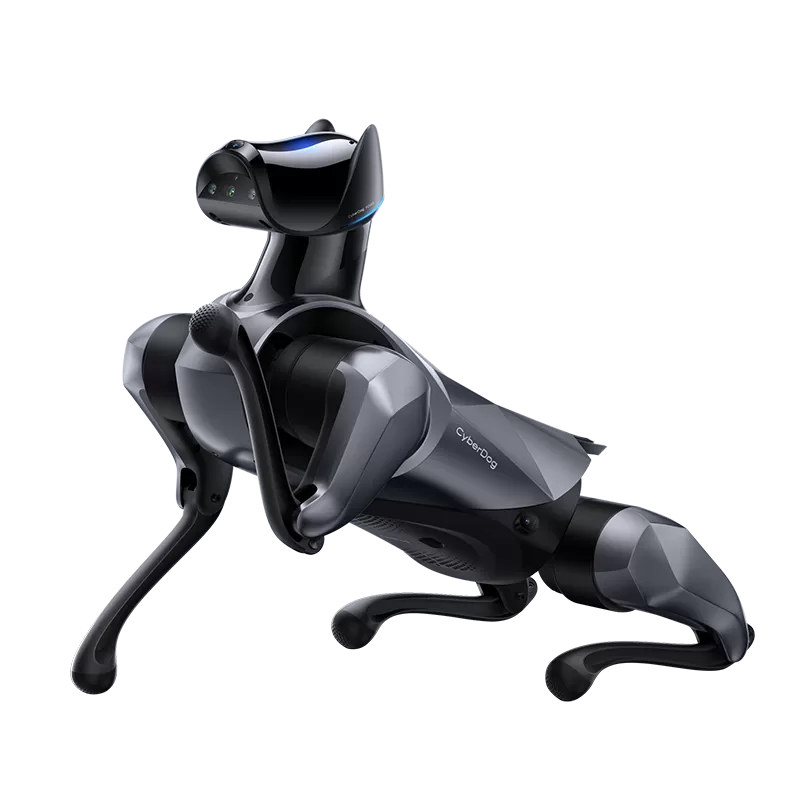
- Locomotion: Multiple gaits including standing, trotting, jogging, jumping, and backflips.
- Perception: 11 sensors enable 3D environment mapping, facial recognition, and object tracking.
- Interaction: Supports XiaoAI voice commands, app control, and multi-modal communication.
- Navigation: Uses SLAM for autonomous indoor positioning and path planning.
- Expandability: Multiple USB Type-C and HDMI ports for add-ons like LiDAR and cameras.
The Xiaomi CyberDog robot dog is an advanced open-source quadruped robot designed for developers, engineers, and robotics enthusiasts seeking a powerful and affordable AI platform.
Developed by Xiaomi, CyberDog combines cutting-edge robotics, artificial intelligence, and high-performance hardware into a compact, bio-inspired robotic companion. Built to mimic the movement and behavior of a real dog, it can walk, run, jump, follow users, and perform dynamic actions like backflips.
Powered by the NVIDIA Jetson Xavier NX AI platform, CyberDog delivers real-time computing for computer vision, autonomous navigation, and AI-based interaction.
The robot features 11 high-precision sensors, including depth cameras, ultrasonic sensors, GPS, and touch sensors, enabling accurate environmental perception, obstacle avoidance, and human interaction.
Designed with an open-source ecosystem, CyberDog supports ROS 2, Ubuntu, and SDK development tools, allowing users to build custom applications, integrate AI models, and experiment with robotics algorithms.
Whether used for AI research, robotics development, education, or as a smart companion, Xiaomi CyberDog offers one of the most accessible entry points into advanced quadruped robotics.
Model: Xiaomi CyberDog
Developer: Xiaomi
Type: AI Quadruped Robot Dog
Dimensions:
- Length: ~560 mm
- Width: ~340 mm
- Height: ~480 mm
Weight: ~14 kg
Degrees of Freedom: 12 DoF (3 per leg)
Mobility:
- Quadruped locomotion
- Max speed: ~1.6 m/s
Actuators:
- 12 high-torque servo motors (custom-built)
AI & Computing:
- NVIDIA Jetson Xavier NX
- AI vision & real-time processing
Sensors:
- Intel RealSense depth camera
- AI cameras (binocular + fisheye)
- Ultrasonic sensors
- GPS
- Touch sensors
Navigation:
- SLAM-based mapping
- Object tracking & obstacle avoidance
Software:
- Ubuntu + ROS 2
- Open-source SDK for development
Battery Life: ~60 minutes
Payload Capacity: ~1 kg
Applications:
- Robotics research & AI development
- Education & STEM training
- Autonomous navigation testing
- Smart companion robotics